

Discover the island of Milos
The island of Milos
Ancient treasure
A strategic island
Milos, the fifth largest island in the Cyclades, stands out for its unique morphology, dominated by a vast natural gulf.Its strategic position on the Aegean sea routes and the exceptional wealth of its subsoil have ensured its continued importance since prehistoric times.
A Lacedaemonian foundation
According to ancient authors, the city of Milos was founded by the Lacedaemonians of the southern Peloponnese, as evidenced by the fact that the inhabitants of Milos spoke a Doric dialect, like those of the neighbouring island of Thera (now Santorini). The exact date of its foundation remains debated, but it probably occurred during the 9th or 8th century BC.
Among the earliest archaeological evidence of the city’s existence are funerary inscriptions and ceramic shards from the Archaic period, as well as coins dating from the late 6th century BC. These coins already bore on one side a fruit (pomegranate or quince), the symbol of the city – in ancient Greek, mèlon means ‘fruit’ – which also appears on coins from both the Classical and Roman imperial periods.
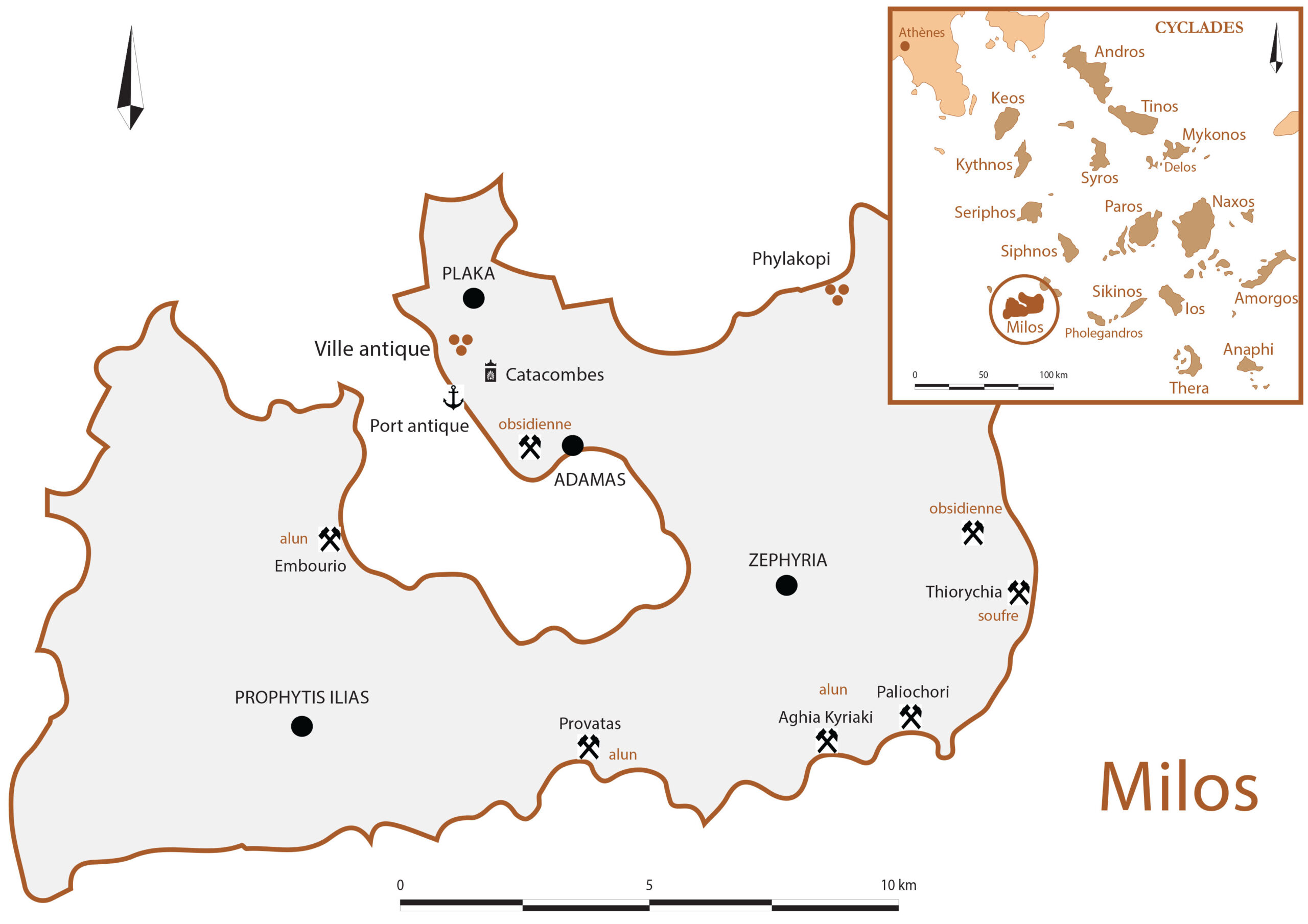
Ancient and archaeological sites on the island of Milos
(© E. Le Quéré)
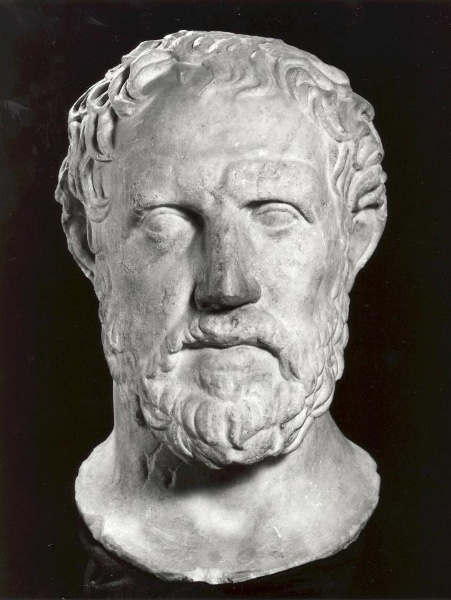
Marble bust of Thucydides, based on an original from the early 4th century BC
(© Royal Ontario Museum, n°957.159)
History of Milos
Thucydides
« Melian Dialogue »
The tragic episode in Melian history in 416–415 BC gave rise to a famous passage in the work of Thucydides (ca. 460–395 BC), known as the «Melian Dialogue », which has been discussed by many philosophers and politicians ever since. Featuring Athenian strategists and representatives of Milos during talks on the eve of the siege, this dialogue presents an ideological debate on the exercise of imperial and coercive power.
The Athenians simply defend the right of the strongest as a law of nature, a position that could be described as Realpolitik and summed up in the famous phrase: « You know and we know, as practical men, that the question of justice arises only between parties equal in strength, and that the strong do what they can, and the weak submit » (Thucydides, The Peloponnesian War, V, 89-116). In contrast, the Melians defend the right to freedom and autonomy, based on considerations of morality and justice. However, this debate did not lead to negotiation: the Athenians maintained their ultimatum – surrender and pay tribute to Athens, or be destroyed – and the Melians chose to risk their fate and hope that Sparta would intervene on their behalf rather than give up their freedom.
Treasures of Milos
Ancient sites on the island of Milos
Topography and plan of the ancient city
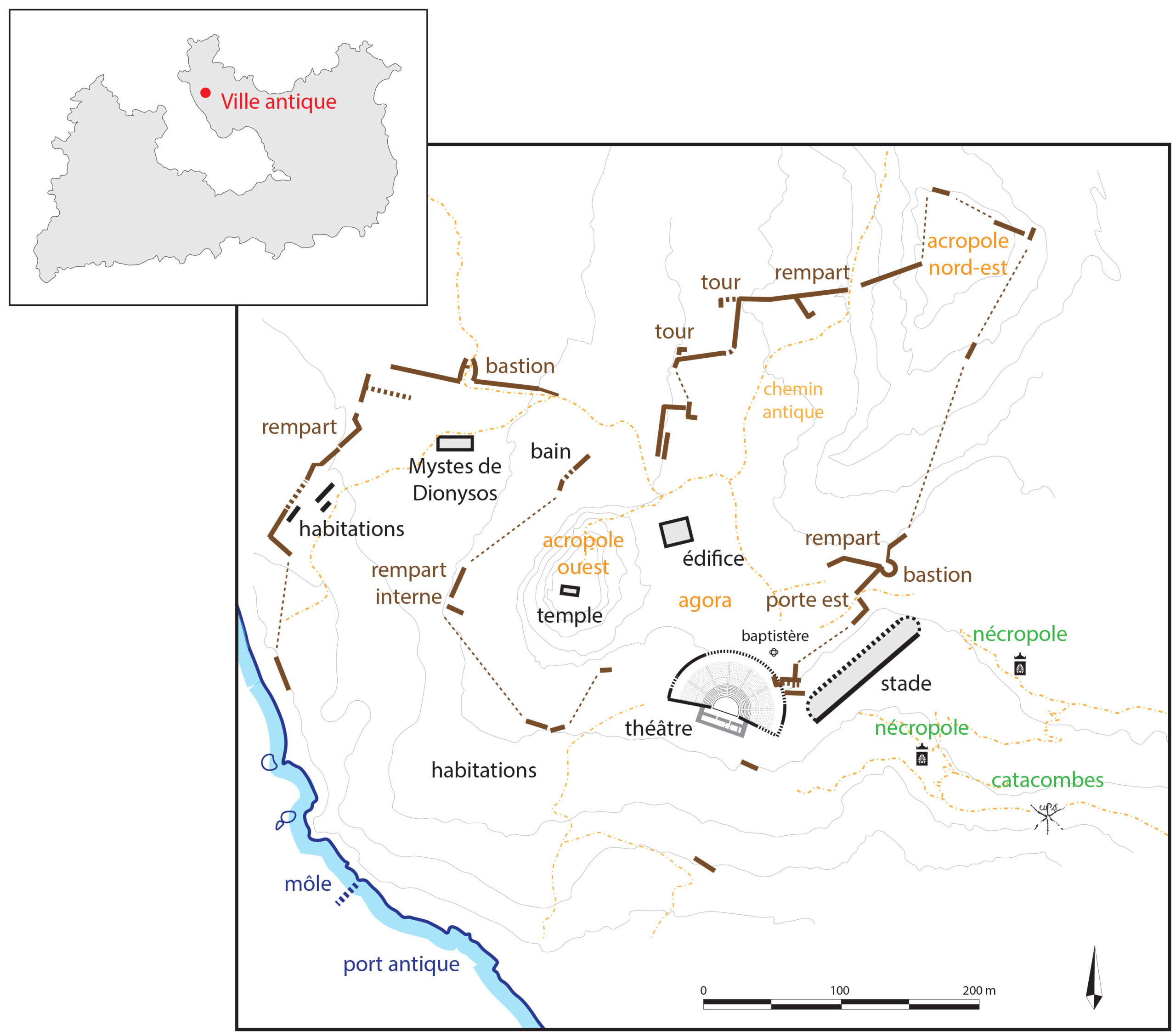
Map of the ancient city of Milos
(© E. Le Quéré, from RENFREW & WAGSTAFF 1982, p. 54 και ΠΑΝΤΟΥ et al. 2015, p. 4)
In historical times, the administrative and urban centre of the island overlooked the eastern entrance to the central gulf and was continuously occupied from at least the 8th century BC to the 6th century AD.
Walls et acropolises
The ancient city of Milos was dominated by two acropolises: one to the west, which had a temple – now replaced by the church of Prophitis Ilias – and the other to the north-east, rising to an altitude of 198 m. The city was surrounded by strong fortification walls, still largely visible, and sometimes preserved to a height of nearly 4 to 5 m, and equipped with several towers, bastions and posterns.
Over 1,800 m long, these ramparts protected an area of approximately 15 hectares, including the two acropolises, the agora, the ancient port of Klima, and several dwellings, the remains of which have been found mainly on the western and southern slopes of the city.
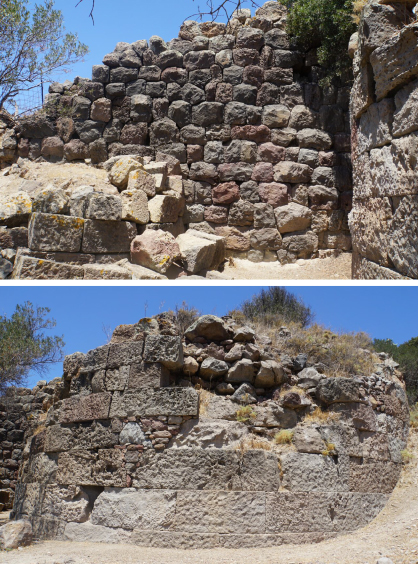
Wall and circular tower at the eastern bastion of the town
(views from the south © E. Le Quéré)
The ancient port of Klima
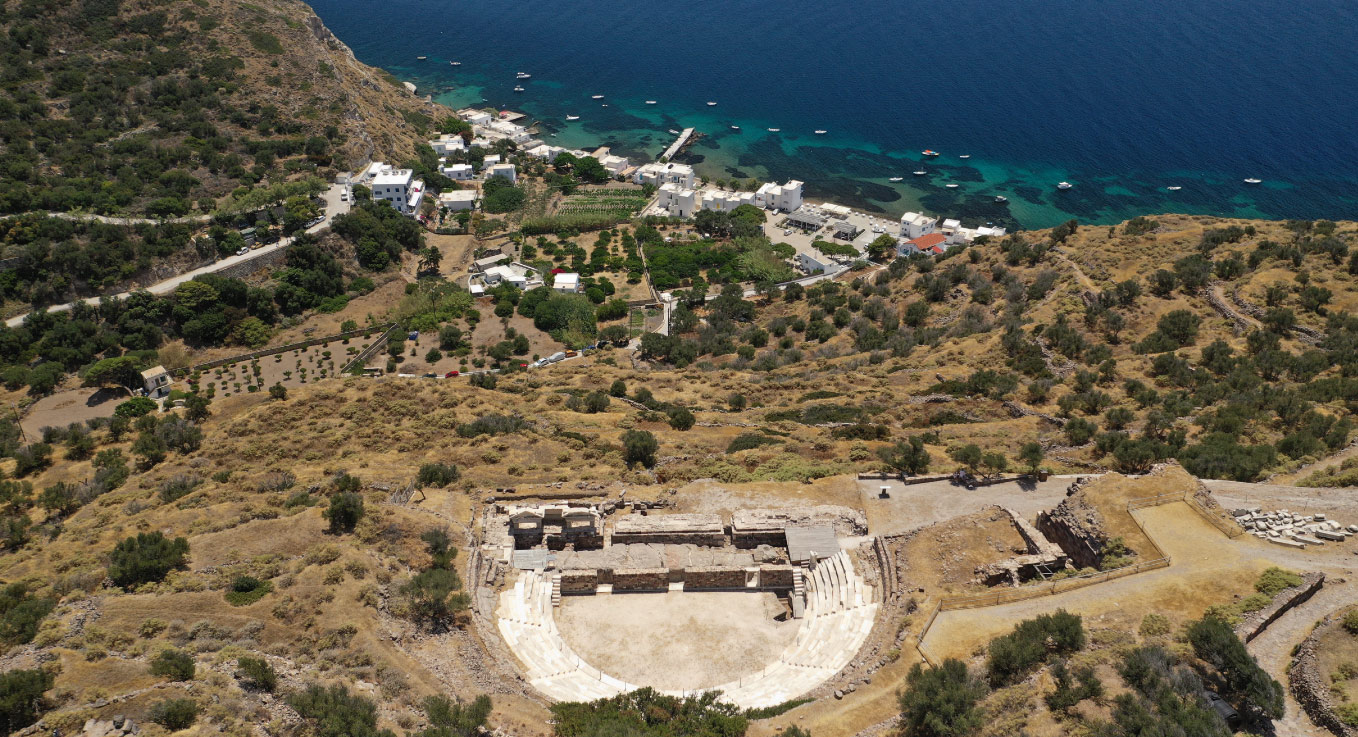
The theatre and the ancient port below, now called Klima
(view from the north-east © Adobe Stock)
From the ancient port of Klima, located south-west of the city, the remains of two piers survive.
Partial excavations of the port have also uncovered remains from the Roman and Proto-Byzantine periods, including several porticoes and sculptures, among which is a magnificent equestrian statue.
The agora
Between the two acropolises, a flat area likely housed the political centre of the city. At its centre stand the remains of an imposing quadrangular building, the function of which remains unknown.
Excavations in this area have yielded a wealth of material from the Roman period – including imperial portraits, statues, honorary inscriptions, capitals and columns probably from porticoes – as well as from the Proto-Byzantine period, notably the remains of a church and a cruciform baptistery.
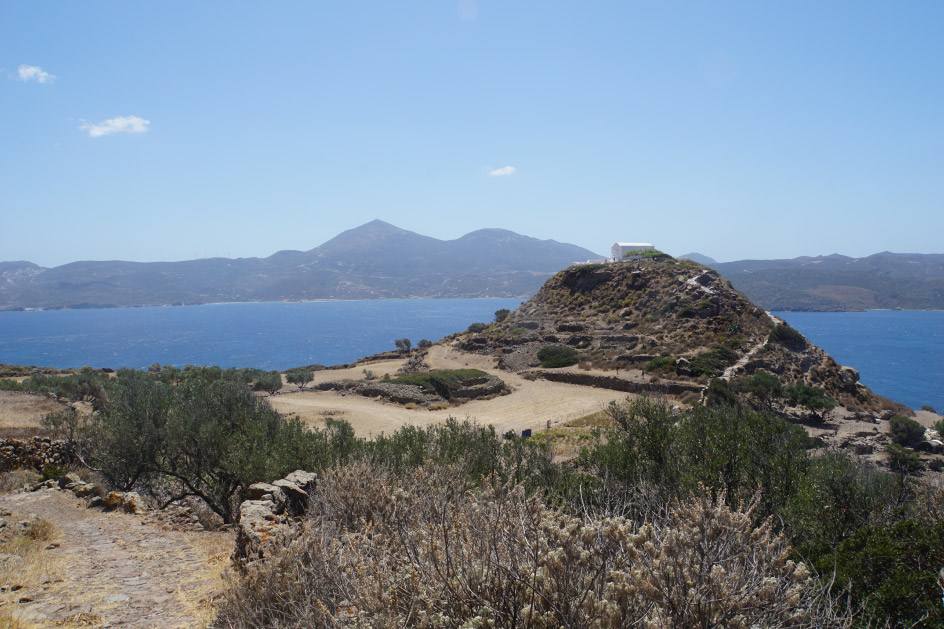
The ancient road (left), the agora (centre) and the western acropolis (right)
(view from the north-east © E. Le Quéré)
Stadium and gymnasium
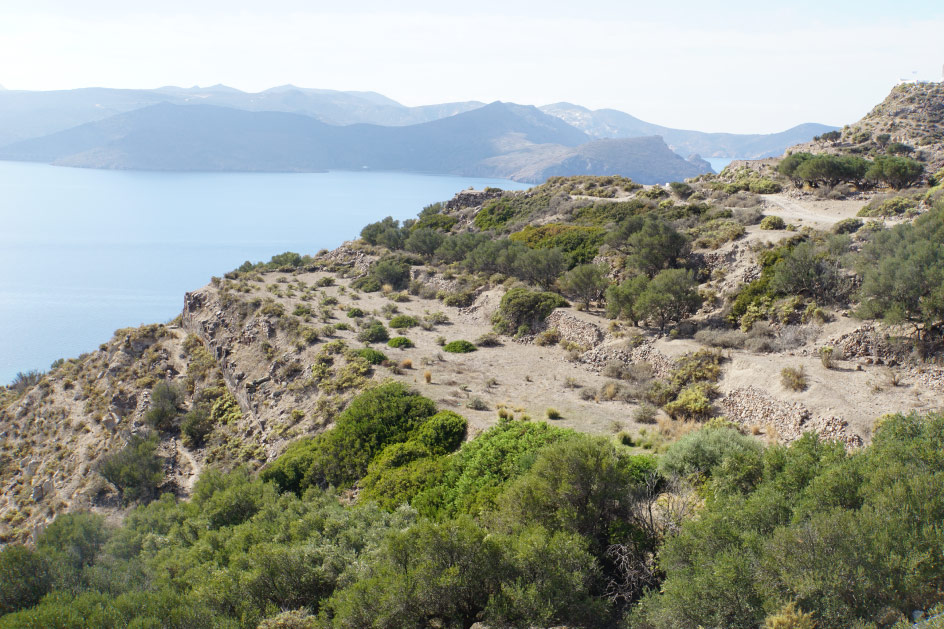
The ancient stadium
(view from the south-east © E. Le Quéré)
To the southeast of the agora, terraced on the hillside, stood buildings dedicated to leisure and entertainment. In this area, during the excavation of a building traditionally identified as a gymnasium, the famous statue of Aphrodite was discovered, along with a portrait of the god Asclepius (now in the British Museum). However, further excavations are required in this area to determine the exact nature of the building that housed the statue and its context.
Immediately to the south, a stadium stretched nearly 125 m. Characterised by an impressive polygonal retaining wall, it had tiers of seats on its northern side.
Theatre
To the south of the agora stands the city’s iconic monument: the theatre. Partially uncovered in 1836, then fully excavated and restored between 2010 and 2015, it was built in the 2nd century AD and originally had more than forty rows of white marble seats.
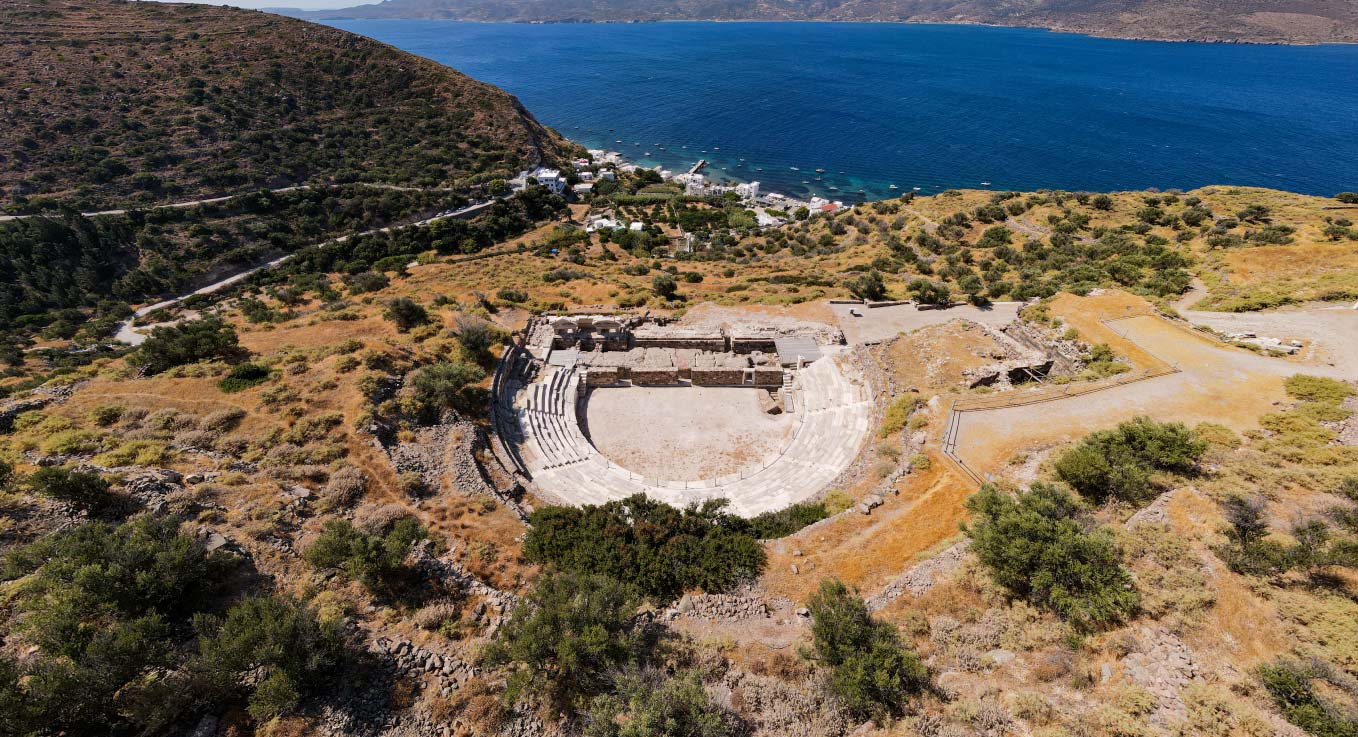
The ancient theatre
(© Adobe Stock)
Necropolises and catacombs
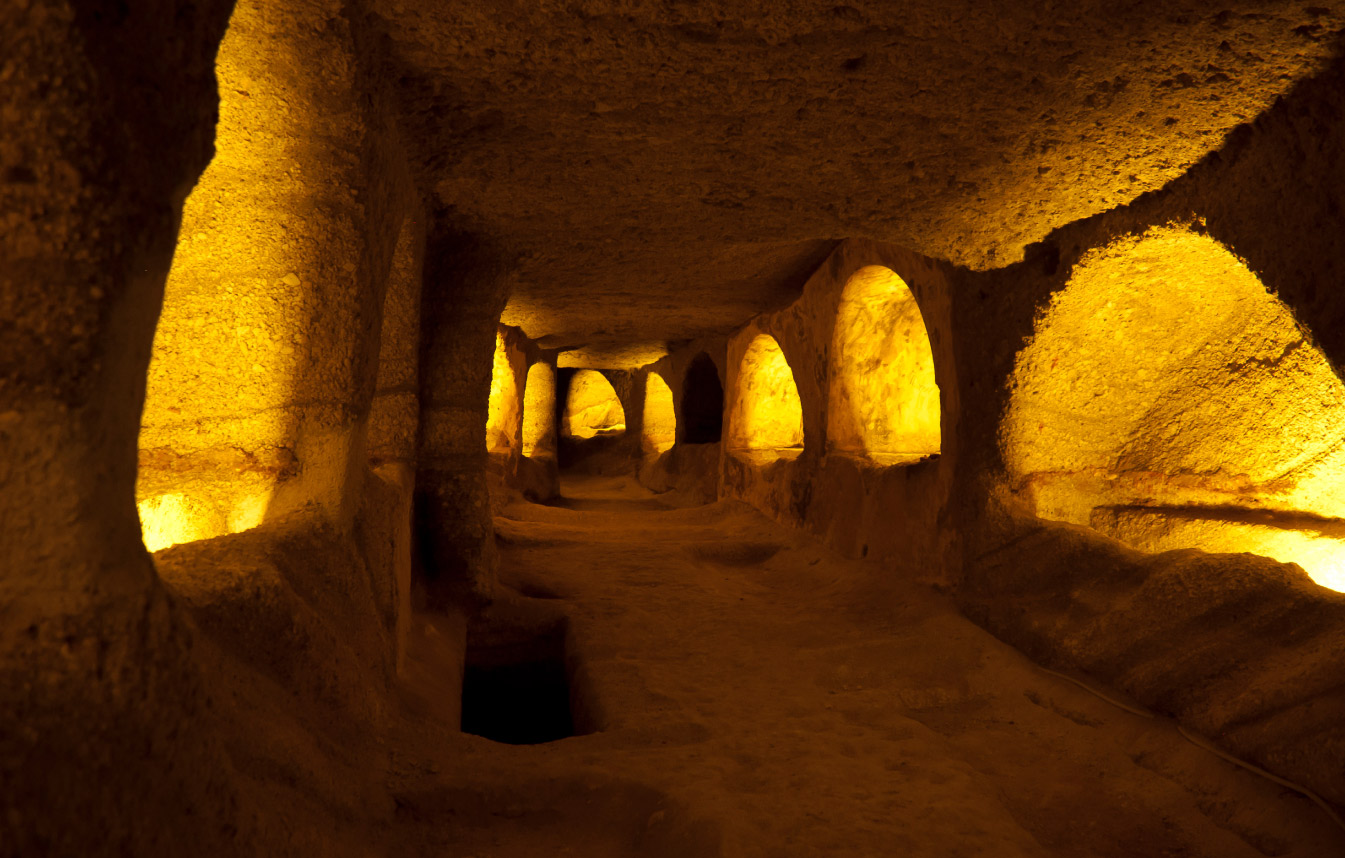
Central gallery of the catacombs
(© Adobe Stock)
The necropolises, in use since the 8th century BC, were situated outside the city walls, to the east and south-east of the city. This area also contains catacombs, which are extremely rare in the Greek world.
Carved into the rock, these catacombs consist of galleries and rooms up to 3 m high, with a preserved length of approximately 200 m. They are believed to have contained between 300 and 1,000 tombs and several thousand deceased, mainly from the 3rd and 4th centuries AD, as indicated by inscriptions, some of which display Christian symbols.
The “Hall of the Mystae” of Dionysus
In the valley to the north-west of the city, a building has been identified as a meeting place for a mystical association dedicated to the cult of Dionysus (2nd–3rd century AD). It had a floor paved with a remarkable mosaic and yielded several altars, reliefs, and statues.
To the east of the sanctuary, the remains of baths and a Roman aqueduct have also been found.
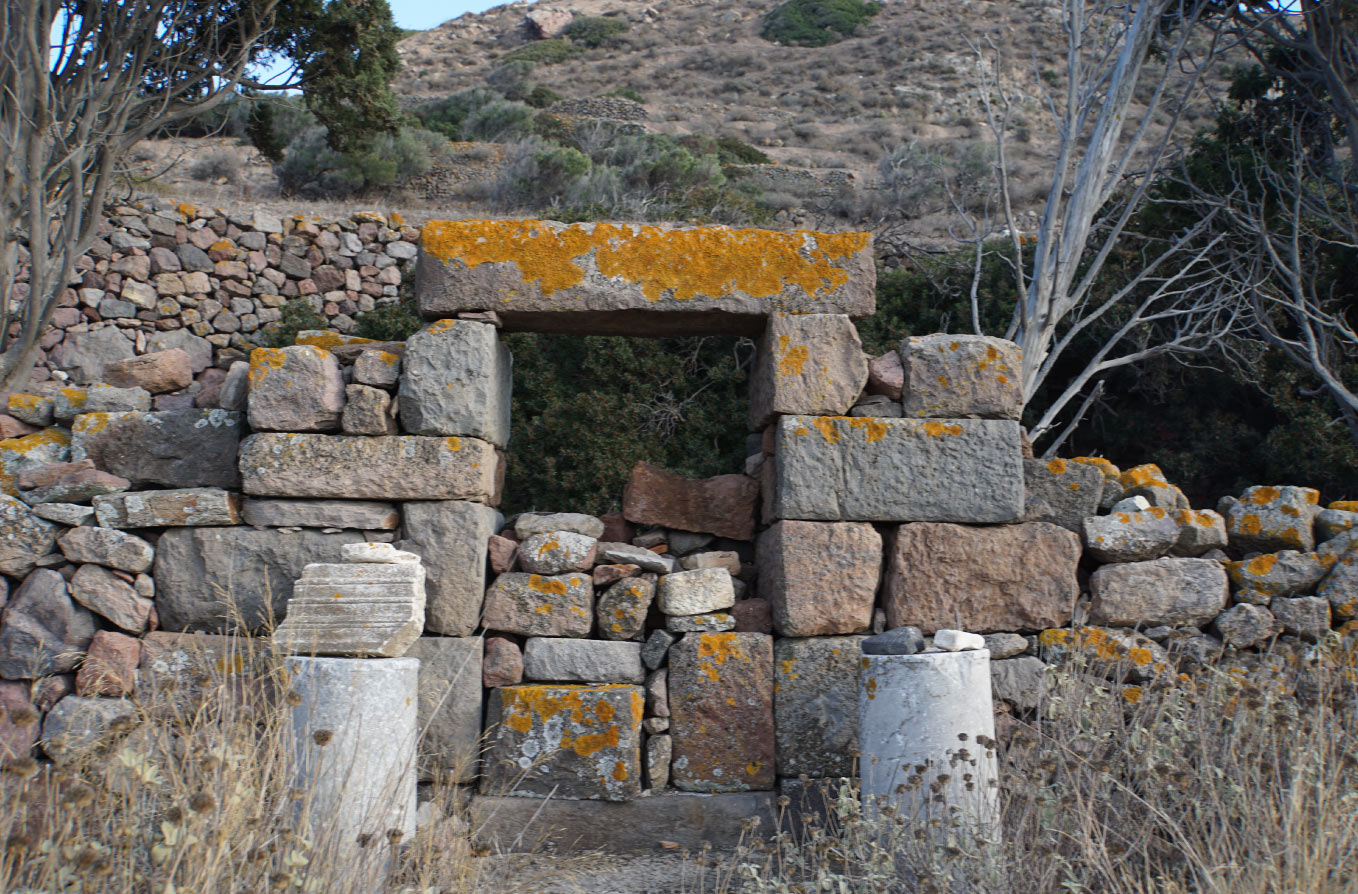
Entrance to the sanctuary called “Hall of the Mystae” of Dionysus
(view from the north © E. Le Quéré)
Studies and research
Milos alum
Exploiting a fundamental resource for ancient economies and crafts
Five-year programme (2024–2028)
Director: Enora Le Quéré (University of Rouen-Normandy; GRHis – UR 3831)
In collaboration with: Peguy Pandou (Ephoria of Classical Antiquities of the Cyclades)
Due to its wealth of natural resources, the island of Milos has always been intensively exploited for its rocks and minerals. In ancient times, Milos mainly suppliedmelinum (ormelian earth), de pumice, alum and sulphur, with the latter two minerals being particularly renowned among the ancients. Alum was used in tanning, dyeing textile manufacturing, paint colours, metal purification and pearl whitening. It was also widely used in cosmetics(for making make-up and various powders), medicine and pharmaceuticals
Its many uses made alum an essential material for various sectors of the ancient economy and crafts. It was therefore intensively exploited wherever it was found, as it is an extremely rare resource in the Mediterranean basin. The island of Milos was thus of great strategic importance for access to this natural resource, particularly during the Roman Empire. Nevertheless, this distinctive feature of the Cycladic island has long been underestimated.
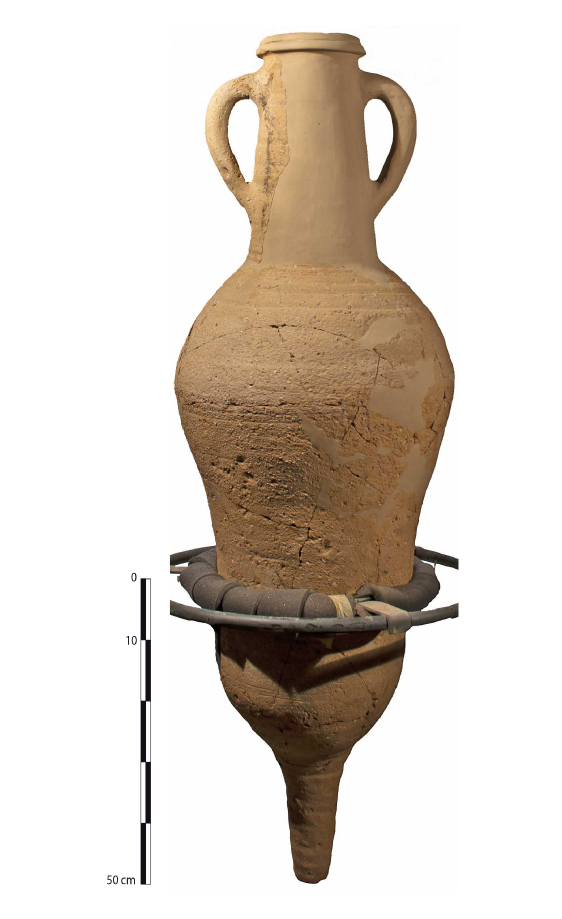
Alum amphora from Milos dating from the 3rd century AD, found in Novara (Piedmont, Italy)
(© https://archaeologydataservice.ac.uk, from QUIRI & SPAGNOLO GARZOLI 2015)
This programme therefore aims to provide an overview of alum mining in Milos in ancient times, from extraction to processing and export.
Thanks to numerous archaeological excavations and surveys conducted on the island since the 1970s, several dozen alum mining sites and processing workshops have been uncovered, particularly in the south-east of the island, near the bays of Paliochori and Aghia Kyriaki.
The aim is to gather all available archaeological documentation concerning these sites (archives, plans, photographs, excavation notebooks, etc.) and to study all the associated material, including tens of thousands of ceramic shards covered with alum crystals, huge jars (pithoi), large terracotta basins of various shapes and sizes (lékanai) and numerous fragments of amphorae or complete amphorae. All of this is recorded in a database linked to a Geographic Information System (GIS).
– From a historical and archaeological perspective : one unresolved problem is determining the natural form of Milos alum, the form in which it was traded, and the stages of its transformation. Equipment found in the island’s ancient workshops suggests that this mineral underwent a lengthy transformation process, which still requires detailed study. Furthermore, as its transport in amphorae indicates that alum was traded in a more or less liquid form.
– From the perspective of the local operating system, in relation to social and economic history : Who owned the workshops ? Who profited from the exploitation of this resource ? Some basins and amphorae bear stamps (marks impressed before firing with a seal) indicating the names of individuals, all of which are Roman names (on a Greek island!). These are probably the marks of private alum mining properties, wholly or partly owned by Romans. However, further research is needed.
– From the perspective of marketing and product distribution : Milos alum was intended for trade, as evidenced by the amphorae, the typology of which has yet to be fully established. Amphorae from Milos have been found throughout the Mediterranean basin, including southern France, northern Italy, Cyprus, and Alexandria in Egypt. It will therefore be necessary to understand the chronology and extent of this commercial phenomenon, as well as the uses of Milos alum at the import sites.
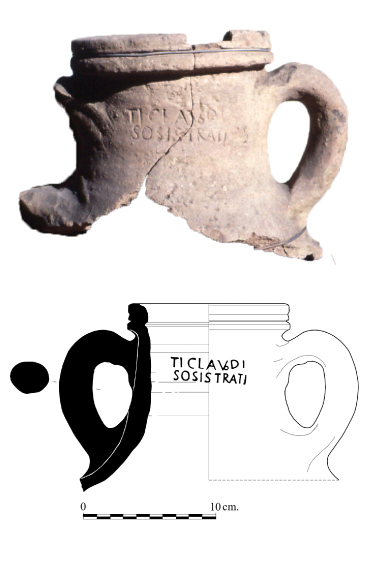
Alum amphora neck from Milos dating from the 2nd century AD, found in Vercelli (Piedmont, Italy), bearing the stamp TI CLAVDI SOSISTRATI, for Ti(berius) Claudi(us) Sosistratus.
(© https://archaeologydataservice.ac.uk, from BRECCIAROLI TABORELLI 1987)
L’association Philomilos = Ο σύλλογος Φιλομήλος
Association of Friends of Milos
History and Archaeology
Objectives :
The aims of this association are:
– to encourage historical and archaeological studies on the island of Milos, as well as research and publication of works on Milos’s history, archaeology and heritage;
– to carry out activities in the fields of scientific research and heritage promotion in Milos;
– to contribute to knowledge of the history, archaeology and preservation of the island’s heritage.
To this end, it may support field studies conducted by its members or collaborators, and the publication of work produced within the association, also by its members or collaborators.
The board of directors:
The board of directors currently consists of four members:
– President : Mattéo LÉPÉE
– Vice-President : Alexandre VIAL
– Secretary : Chloé BECHEMIL
– Treasurer : Enora LE QUÉRÉ
Members and memberships fees :
– Associate members are those who have committed to paying an annual membership fee of €5.
– Active members are those who have committed to paying an annual membership fee of €10.
– Benefactor members are those who have agreed to pay an annual membership fee of more than €10 or to make regular donations to the association in order to provide financial support.
– Honorary members are those who have rendered significant services to the association; they are appointed by the general meeting in recognition of their services and are exempt from membership fees
To become a member :
To join our association, you can download the membership form below and return it, duly completed, to the following address : philomilos1@gmail.com
Download the membership form in PDFContact us:
If you have any questions or require further information, please do not hesitate to contact us at the following address : philomilos1@gmail.com