

Studies and research
Milos alum
Exploiting a fundamental resource for ancient economies and crafts
Five-year programme (2024–2028) of the Ephorate of Antiquities of Cyclades
Director: Enora Le Quéré (University of Rouen-Normandy; GRHis – UR 3831)
In collaboration with: Peguy Pandou (Ephorate of Antiquities of Cyclades)
Due to its wealth of natural resources, the island of Milos has always been intensively exploited for its rocks and minerals. In ancient times, Milos mainly supplied melinum (or melian earth), pumice, alum and sulphur, with the latter two minerals being particularly renowned among the ancients. Alum was used in tanning, dyeing textile manufacturing, paint colours, metal purification and pearl whitening. It was also widely used in cosmetics (for making make-up and various powders), medicine and pharmaceuticals
Its many uses made alum an essential material for various sectors of the ancient economy and crafts. It was therefore intensively exploited wherever it was found, as it is an extremely rare resource in the Mediterranean basin. The island of Milos was thus of great strategic importance for access to this natural resource, particularly during the Roman Empire. Nevertheless, this distinctive feature of the Cycladic island has long been underestimated.
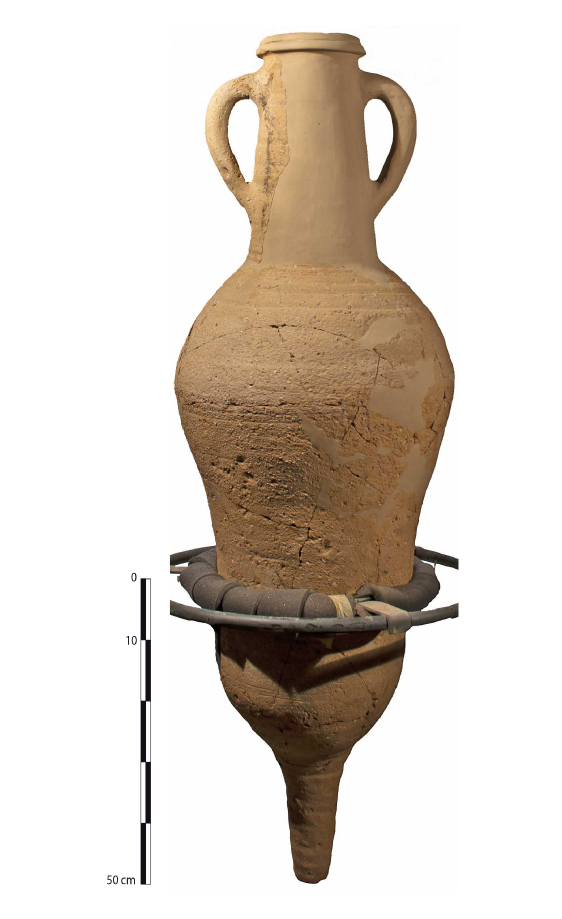
Alum amphora from Milos dating from the 3rd century AD, found in Novara (Piedmont, Italy)
(© https://archaeologydataservice.ac.uk, from QUIRI & SPAGNOLO GARZOLI 2015)
This programme therefore aims to provide an overview of alum mining in Milos in ancient times, from extraction to processing and export.
Thanks to numerous archaeological excavations and surveys conducted on the island since the 1970s, several dozen alum mining sites and processing workshops have been uncovered, particularly in the south-east of the island, near the bays of Paliochori and Aghia Kyriaki.
The aim is to gather all available archaeological documentation concerning these sites (archives, plans, photographs, excavation notebooks, etc.) and to study all the associated material, including tens of thousands of ceramic shards covered with alum crystals, huge jars (pithoi), large terracotta basins of various shapes and sizes (lékanai) and numerous fragments of amphorae or complete amphorae. All of this is recorded in a database linked to a Geographic Information System (GIS).
The objectives of this programme are threefold:
– From a historical and archaeological perspective: one unresolved problem is determining the natural form of Milos alum, the form in which it was traded, and the stages of its transformation. Equipment found in the island’s ancient workshops suggests that this mineral underwent a lengthy transformation process, which still requires detailed study. Furthermore, as its transport in amphorae indicates that alum was traded in a more or less liquid form.
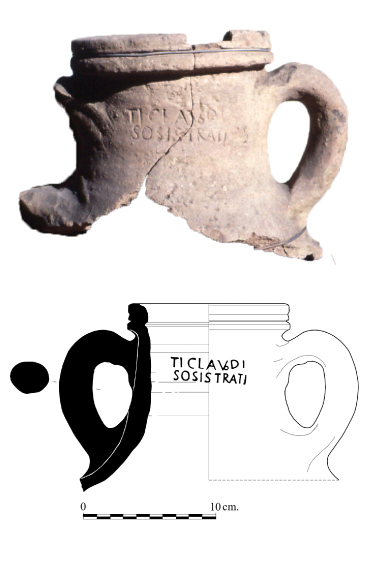
– From the perspective of the local operating system, in relation to social and economic history: Who owned the workshops? Who profited from the exploitation of this resource? Some basins and amphorae bear stamps (marks impressed before firing with a seal) indicating the names of individuals, all of which are Roman names (on a Greek island!). These are probably the marks of private alum mining properties, wholly or partly owned by Romans. However, further research is needed.
– From the perspective of marketing and product distribution: Milos alum was intended for trade, as evidenced by the amphorae, the typology of which has yet to be fully established. Amphorae from Milos have been found throughout the Mediterranean basin, including southern France, northern Italy, Cyprus, and Alexandria in Egypt. It will therefore be necessary to understand the chronology and extent of this commercial phenomenon, as well as the uses of Milos alum at the import sites.