ANCIENT HARBOUR
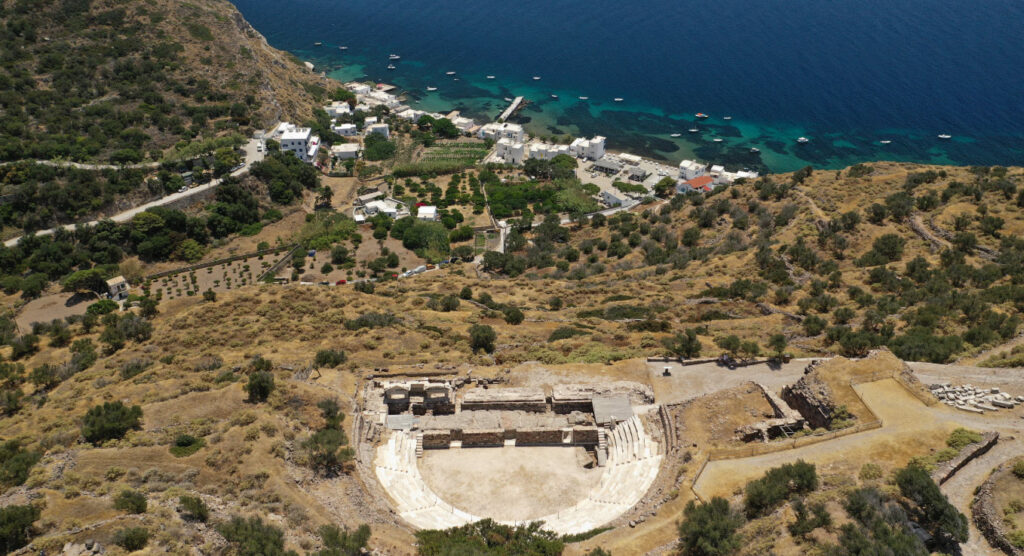
From the ancient harbour, now known as Klima, situated below the town to the south-west, the remains of two jetties are still visible. Partial excavations of the harbour have also brought to light remains dating from the Hellenistic period to Late Antiquity, including a portico, craft and commercial facilities, and sculptures.
To cite this entry:
E. Le Quéré, “Ancient harbour”, Philomilos.org, 2026, en ligne : https://philomilos.org/ancient-sites/ancient-port/
The theatre and the ancient harbour below, now called Klima
(view from the north-east © Adobe Stock)
Port infrastructure and piers
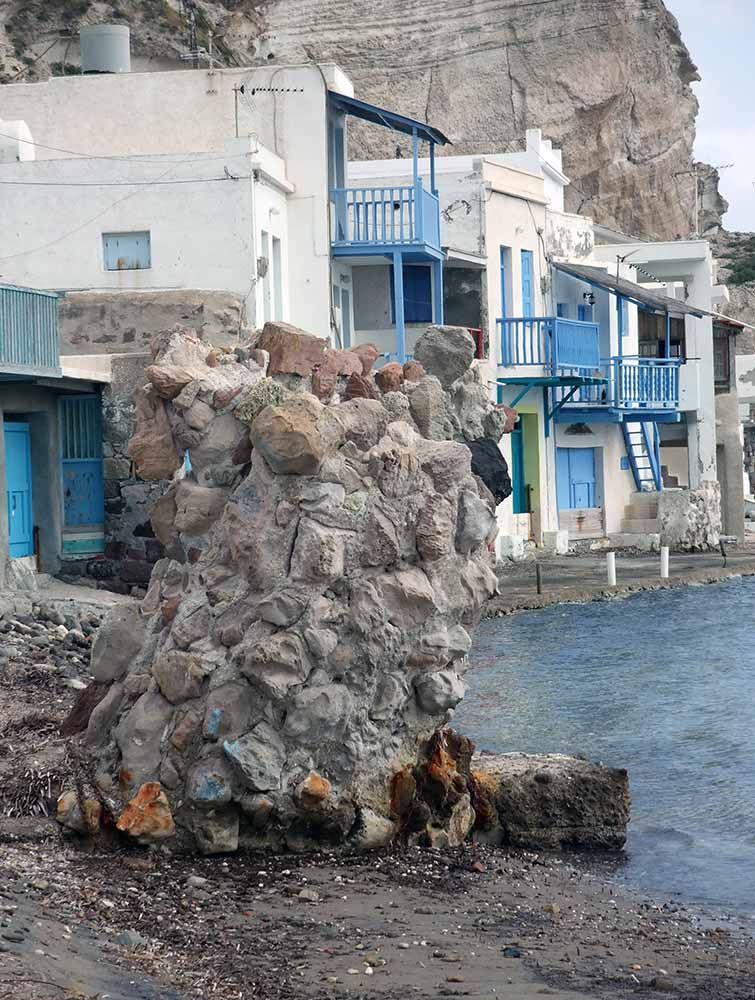
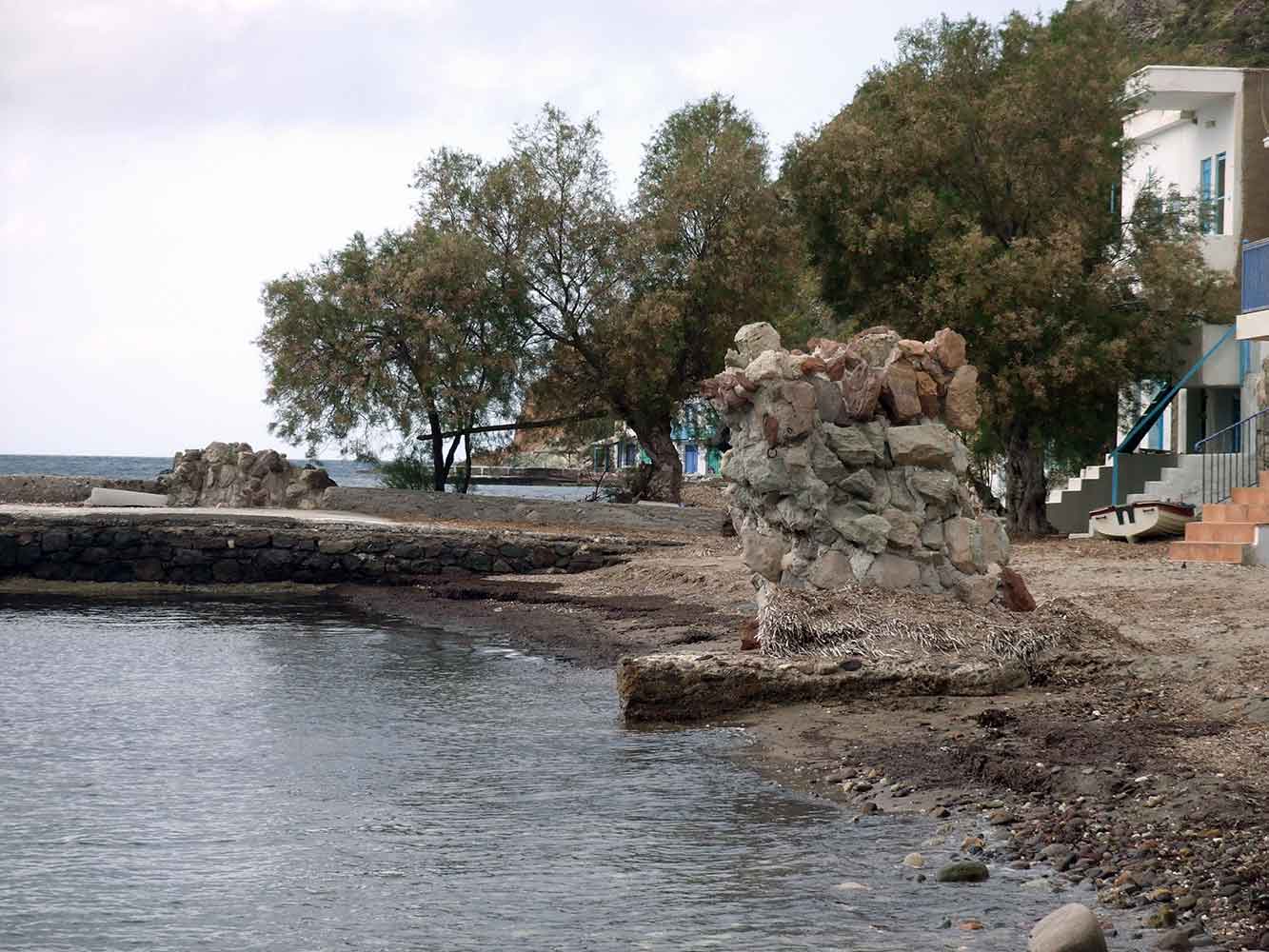
The remains of port infrastructure and two piers are still visible, with substantial traces of massive masonry, mainly at both ends of the base of the delta. These piers consist entirely of large concrete foundations mixed with coarse rock, raised to a level corresponding approximately to the current sea level. Above this, the structure is built of heavy square blocks of red or brown trachyte with an inner core of rubble stone. To the west, out at sea, British archaeologists identified a large rectangular structure at the end of the nineteenth century, which appears to have been connected to the shore by a footbridge; a similar structure seems to have existed at the eastern end. These structures may primarily have served as docks or quays, but they could just as plausibly have formed a solid defensive base against attacks from the sea.


Remains of the eastern pier (view from the west)
(photo: E. Le Quéré © Ministry of Culture - Ephorate of Antiquities of the Cyclades)
Remains of the eastern pier (view from the east)
(photo: E. Le Quéré © Ministry of Culture - Ephorate of Antiquities of the Cyclades)
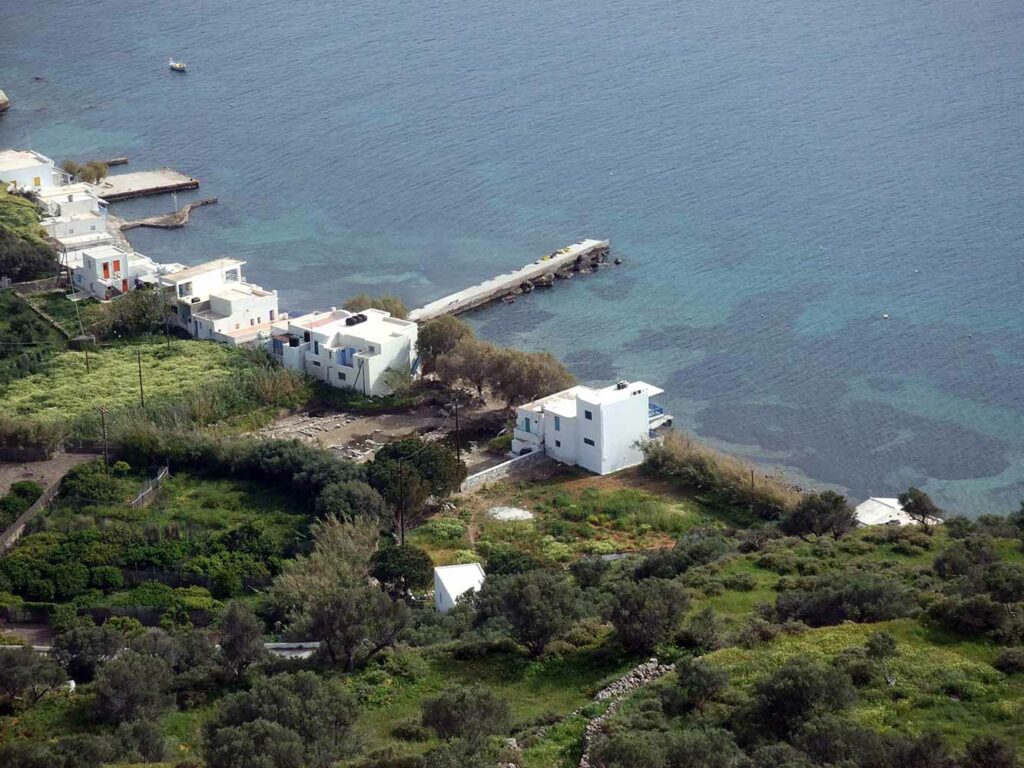
View of the ancient harbour in 2010, showing the remains uncovered during the preventive excavations (view from the north-west)
(photo: E. Le Quéré © Ministry of Culture – Ephorate of Antiquities of the Cyclades)
Craft and commercial facilities
The ancient harbour featured several structures, which were undoubtedly partly used for craft and commercial purposes, but whose functions have not yet been clearly established. Only one of them, previously identified by British archaeologists in the late nineteenth century to the south-east of the harbour, has been definitively identified: it was a portico. Indeed, the archaeologists have identified four aligned bases that once formed part of a colonnade. This portico was probably built during the Roman period using reused materials, as evidenced by the column bases, which are not quite square, nor of the same size, nor placed at exactly equal distances from one another. This portico was completely destroyed in Late Antiquity, and its blocks were reused in neighbouring walls, where a Corinthian column and a fragment of a marble entablature can still be seen.
Preventive excavations carried out in the 1990’s and 2000’s revealed, not far from this portico, two groups of buildings, each comprising several rooms and separated by an alleyway. Several phases of construction were identified, in particular repairs, alterations and additions to the original building. In the northern building, the remains of a vaulted structure were discovered, along with a staircase indicating the existence of an upper storey, as well as a rubbish pit containing burnt shards from large vases. In the western building, a circular structure paved with schist slabs (perhaps an olive press?) and a masonry conduit were among the structures unearthed.
Statues from the Hellenistic and Roman periods
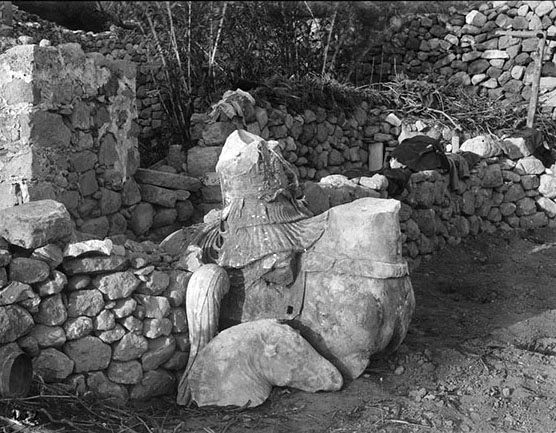
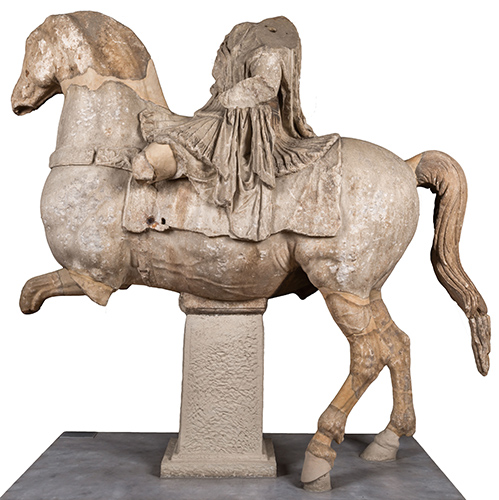
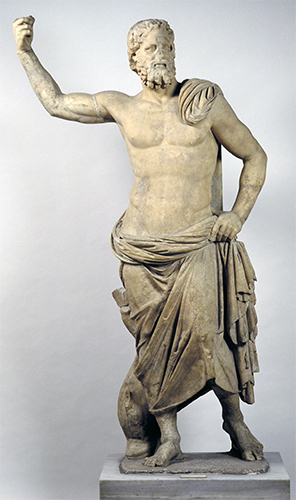
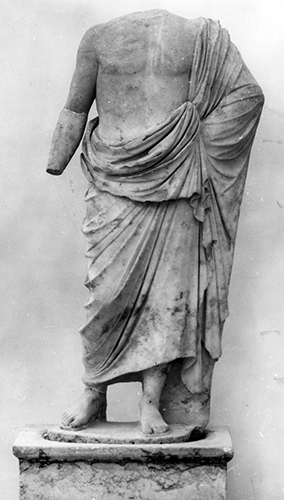
During the nineteenth century, several marble statues and statue bases were discovered in the harbour area. It is not known whether they had been placed there to adorn buildings or gathered together in a Late Antiquity collection, perhaps to be turned into lime. Among them is the magnificent statue of Poseidon, 2.35 m tall, of Parian marble and dating to the last quarter of the 2nd century BC; a statue of a man wearing a himation, dating from the last quarter of the 1st century BC, but set upon a 4th-century BC plinth that had been recut and reused to accommodate the present statue; and a magnificent equestrian statue, dating to the late 2nd century or early 1st century BC.


Roman equestrian statue found in Klima in 1896
The restored equestrian statue found at Klima
(HNAM, Athens, Archive, 2715; © Hellenic Ministry of Culture – HOCRED)
The "Poseidon of Melos" found in Klima
(HNAM, Athens, Archive, 235; © Hellenic Ministry of Culture – HOCRED)
Statue of a man wearing an himation found in Klima
(HNAM, Athens, Archive, 237; © Hellenic Ministry of Culture – HOCRED)
Further reading
Cherry, Sparkes 1982: J. F. Cherry, B. A. Sparkes, “A Note on the Topography of the Ancient Settlement of Melos”, in C. Renfrew, M. Wagstaff (éd.), An Island Polity: the Archaeology of Exploitation in Melos, Cambridge, Cambridge UP, 1982, p. 53‑57.
Le Quéré 2015 : E. Le Quéré, Les Cyclades sous l’Empire romain : Histoire d’une renaissance, Rennes, PUR, Histoire, 2015, p. 327-336.
Pandou 1999: P. Pandou, ΑD 54 (1999), Chron. B2, p. 797-799.
Pandou, Efstathiou 2008 : P. Pantou, M. Efstathiou, AD 63 (2008), Chron. B2, p. 1110-1114.
Smith 1895: C. Smith, “Excavations in Melos”, The Annual of the British School at Athens, 2, 1895, p. 63‑76.