TOPOGRAPHY OF THE ANCIENT CITY OF MILOS

In historical times, the island’s administrative and urban centre overlooked the eastern entrance to the central gulf, a few hundred metres west of the modern village of Trypiti. It was continuously occupied from at least the 8th century BC to the 6th century AD.

To cite this entry:

E. Le Quéré, “Topography of the ancient city”, Philomilos.org, 2026, online: https://philomilos.org/ancient-sites/agora/

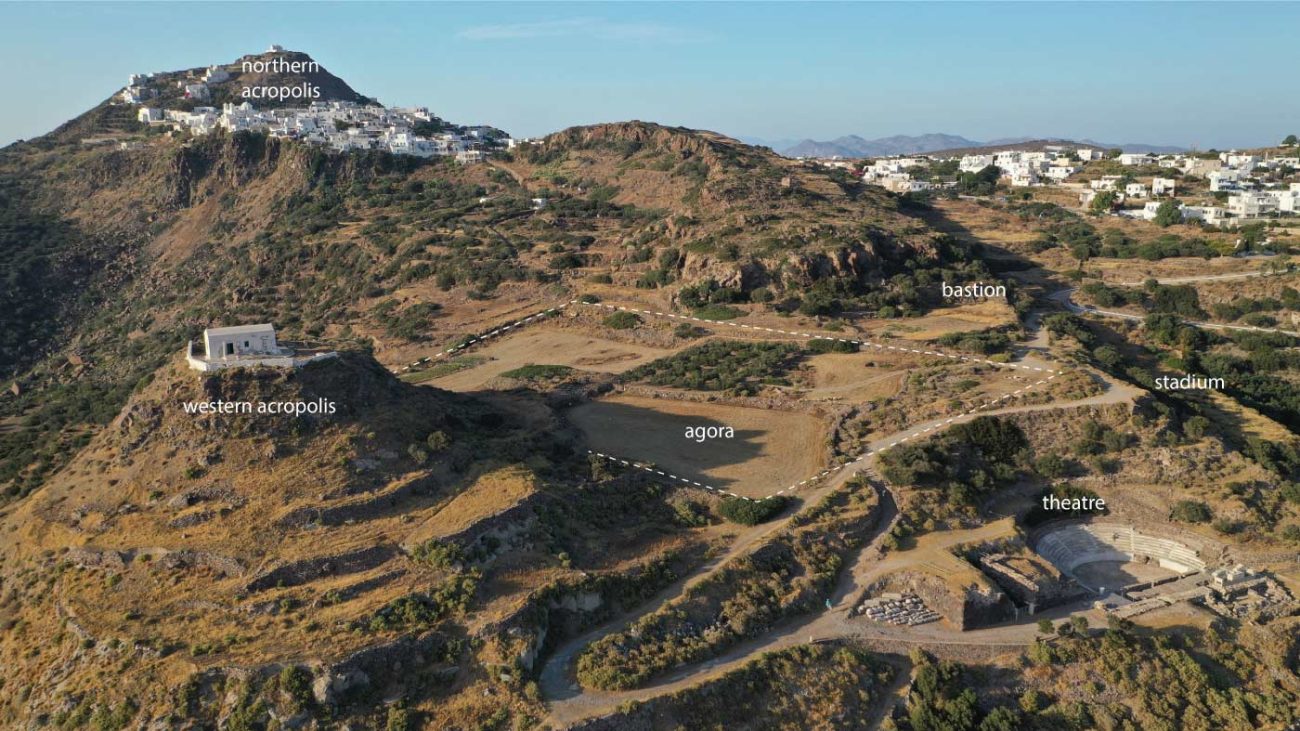
The ancient agora (view from the south-east)

The ancient agora (view from the south-east)

(photo: Enora Le Quéré © Ministry of Culture – Ephorate of Antiquities of the Cyclades)

location-of-the-ancient-city-showing-its-main-monuments-view-from-the-south

Location of the ancient city, showing its main monuments (view from the south)

(© Adobe Stock, with graphic modifications)

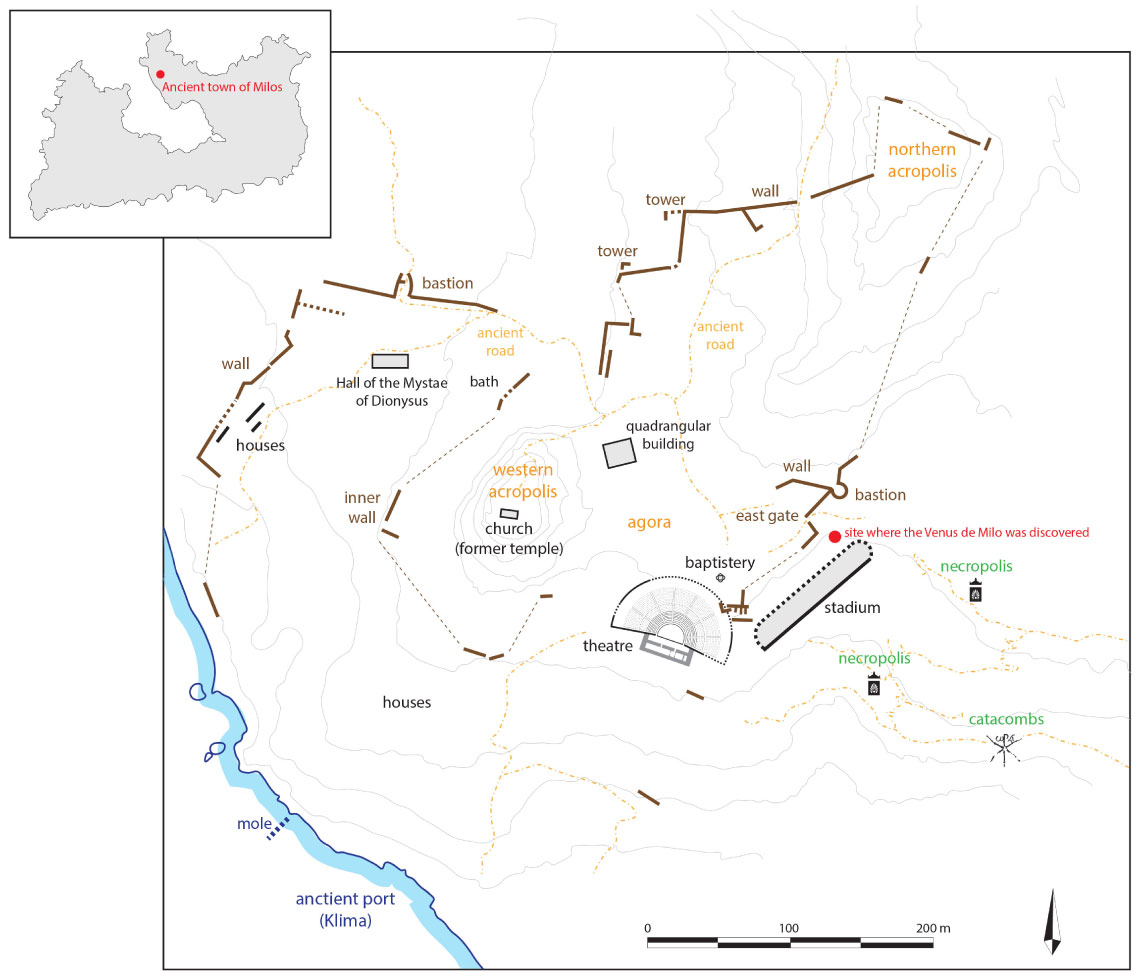
The ancient city of Milos was dominated by two acropolises: one to the west, on which stood a temple, and another to the north-east, rising to a height of 198 metres. The city was surrounded by imposing fortification walls, much of which is still visible today, preserved in places to a height of nearly 4 to 5 metres, and featuring several towers, bastions, and postern gates.

Between the two acropolises, a flat area likely housed the agora, the political centre of the ancient city, bordered to the south by a magnificent theatre with marble tiers and to the south-east by a stadium. The ancient harbour was situated below, to the south-west of the city (now known as Klima Harbour). On the slopes of the hills, within the ramparts, there were also dwellings and other sanctuaries, including the ‘Hall of the Mystae’ of Dionysus.

The necropolises, in use from the 8th century BC, were situated outside the walls, to the east and south-east of the city. This area also contains catacombs, which are extremely rare in the Greek world.
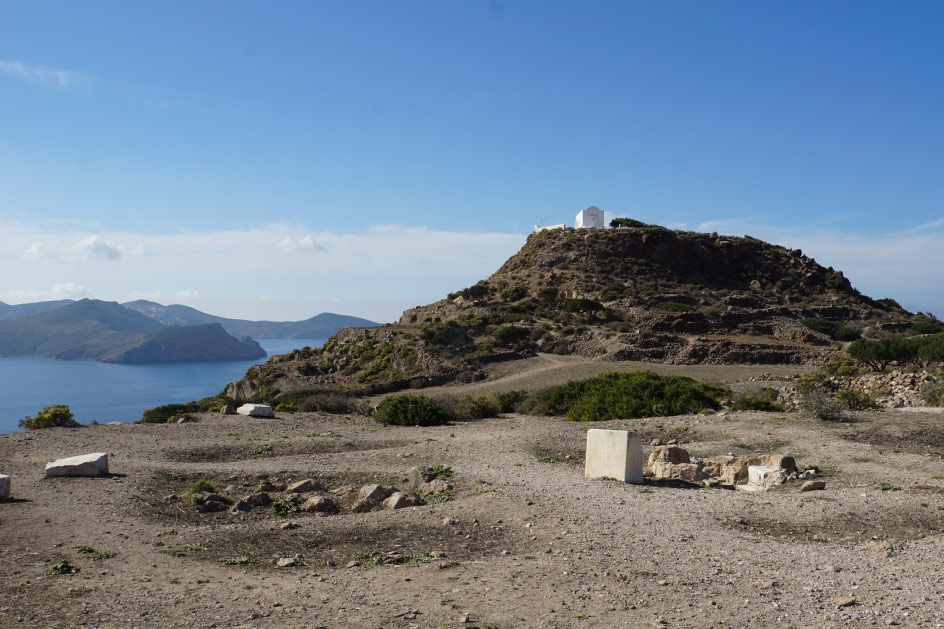
Plan of the ancient city of Milos

(© E. Le Quéré, from Renfrew & Wagstaff 1982, p. 54 and Pandou et al. 2015, p. 4)

Further reading

Cherry, Sparkes 1982: J. F. Cherry, B. A. Sparkes, “A Note on the Topography of the Ancient Settlement of Melos”, in C. Renfrew, M. Wagstaff (éd.), An Island Polity: the Archaeology of Exploitation in Melos, Cambridge, Cambridge UP, 1982, p. 53‑57.

Le Quéré 2021: E. Le Quéré, “La cité grecque de Milos : histoire et urbanisme”, Dossiers d’Archéologie HS, 41, 2021, p. 12‑19.