

NECROPOLISES AND CATACOMBS
The necropolises, in use as early as the 8th century BC, were located outside the city walls, to the east and southeast of the ancient city. This area also contains catacombs, which are extremely rare in the Greek world. Situated about 200 m east of the modern village of Trypiti, they form the largest underground necropolis of the ancient city, in use from the mid-1st to the 6th century AD. Carved into the rock, they consist of galleries and chambers up to 2.5 m high, with a preserved length of approximately 200 m.
To cite this entry:
E. Le Quéré, “Necropolises and catacombs”, Philomilos.org, 2026, en ligne : https://philomilos.org/ancient-sites/necropolises-catacombs/
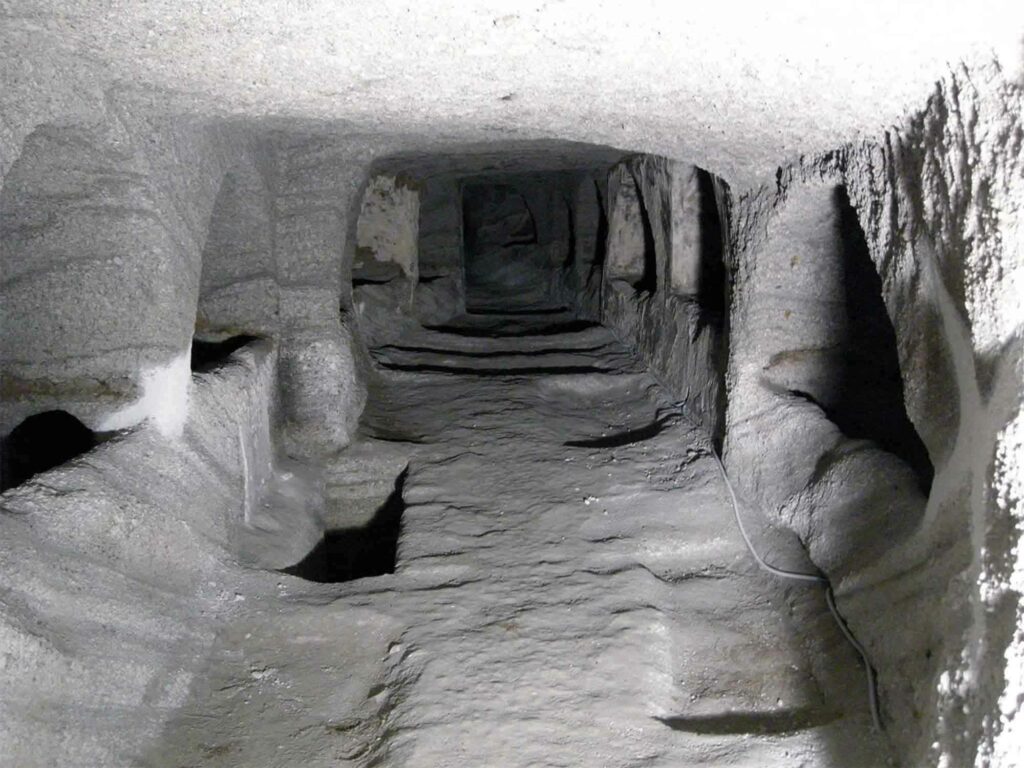
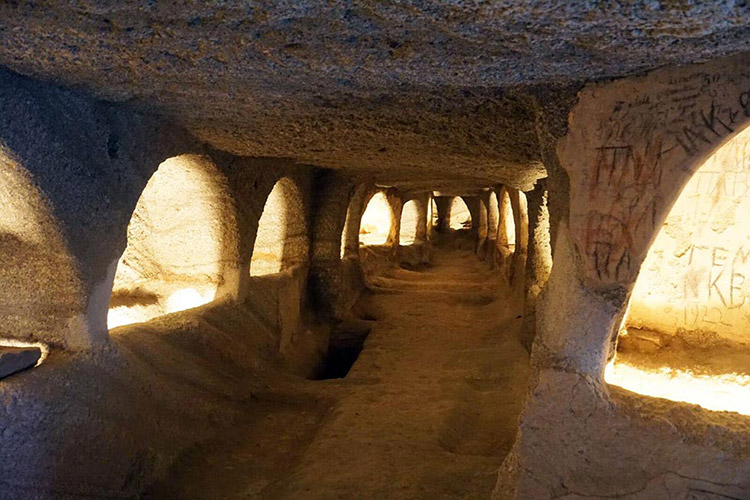
Gallery 1 of the Catacomb A
(© Ministry of Culture – Ephorate of Antiquities of the Cyclades)
The Necropolises
The necropolises, located extra muros like all ancient necropolises, were mainly situated in the eastern and north-eastern parts of the city, although others are found throughout the island. Their tombs have been the subject of recent excavations. Dating from the 8th century BC to the 3rd century A.D., some of the artefacts they contained can now be admired at the Archaeological Museum of Milos.
A path lined with tombs led eastwards from the “East Gate”. It was near this path that the Geometric cemetery, dating mainly from the 8th century BC, was located, and where the 6th-century BC kouros was discovered. The village of Trypiti itself, as its name suggests (literally “perforated, full of holes”), is dotted with tombs carved into the rock, most of which were looted upon discovery. However, excavations conducted further east, at Petralonia and Klimatovouni, have yielded significant collections of jewellery, pottery, and funerary stelae mainly dating from the 6th and 5th centuries BC. The road leading from Klimatovouni to the present-day town of Adamas was lined with tombs on both sides, dating from a slightly later period.
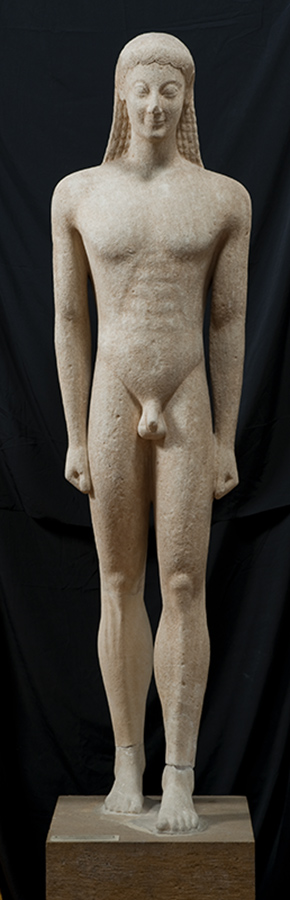
Funerary kouros of Naxian marble (ca. mid-sixth century BC)
(HNAM, Athens, Archive, 1558; © Hellenic Ministry of Culture – HOCRED)
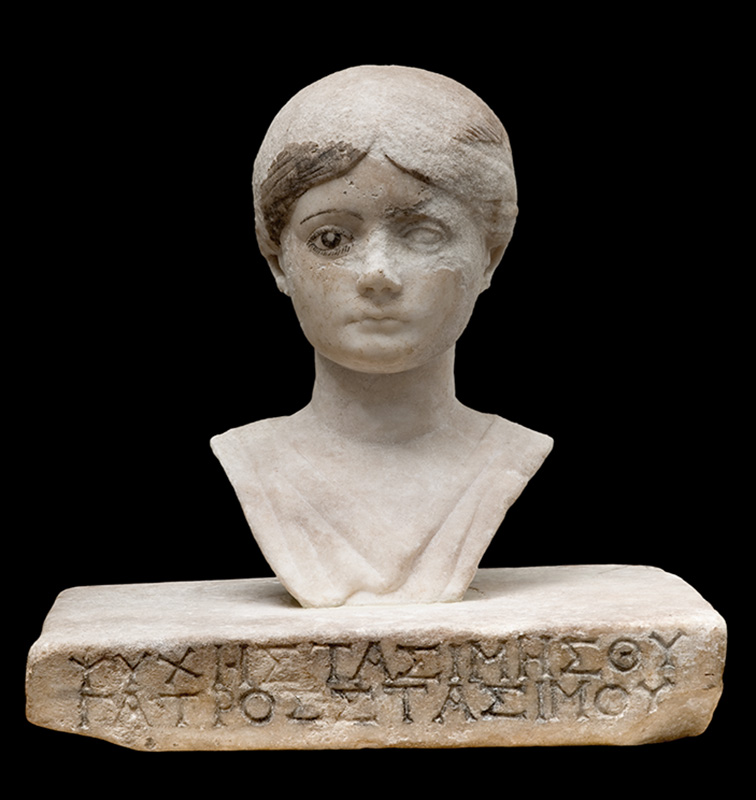
Funerary bust of a young woman named Psyche, which come form a rock-cut family tomb (1st-2nd century AD)
(HNAM, Athens, Archive, 426; © Hellenic Ministry of Culture – HOCRED)


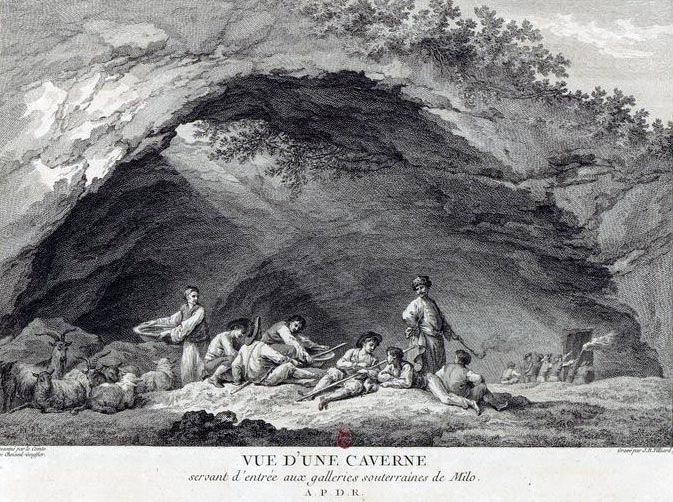
Engraving of the “Greek cave”, one of the entrances to the catacombs
(© Choiseul 1782, pl. 6)
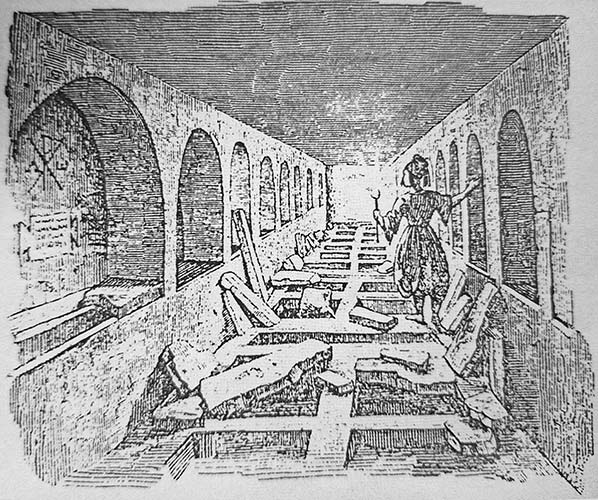
Engraving of one of the galleries of the catacombs
(© Ross 1845, vol. 3, p. 147)
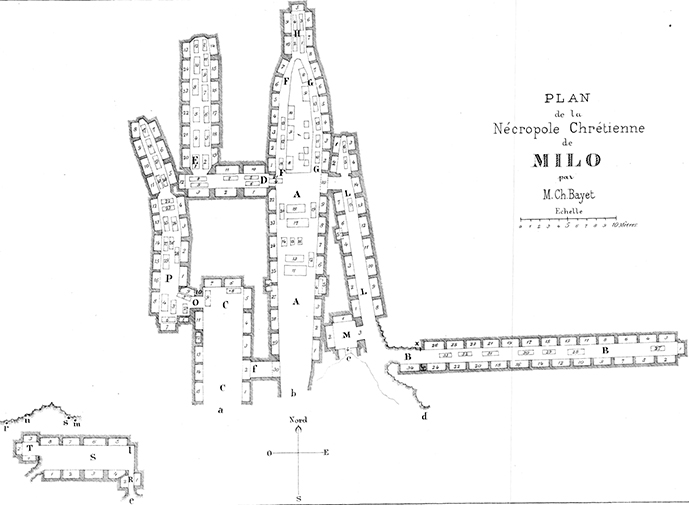
Plan of the catacombs
(© Bayet 1878, p. 348)
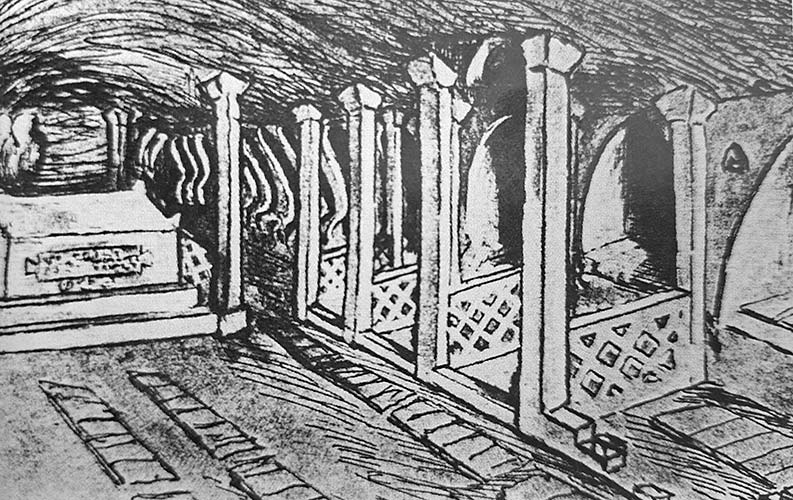
Drawing of the central gallery of the catacombs B
(© Sotiriou 1928)
Discovery, initial explorations, and new excavations
The Catacombs were known to local residents as the “Greek Cave”. Even before the German archaeologist Ludwig Ross visited them in 1844 and produced the first description, they had already been subjected to extensive looting. In 1878, the French archaeologist Charles Bayet visited the site and drew up an initial rough map of the galleries, followed by Georgios Lambakis in 1907. In 1928, they were the subject of more systematic excavations and studies led by Professor Georgios Sotiriou.
Excavations carried out between 2007 and 2009 as part of work to consolidate, protect and improve access to the catacombs, led by the Ministry of Culture and Tourism and the Ephorate of the Cyclades, subsequently brought new findings to light.
Description of the Catacombs
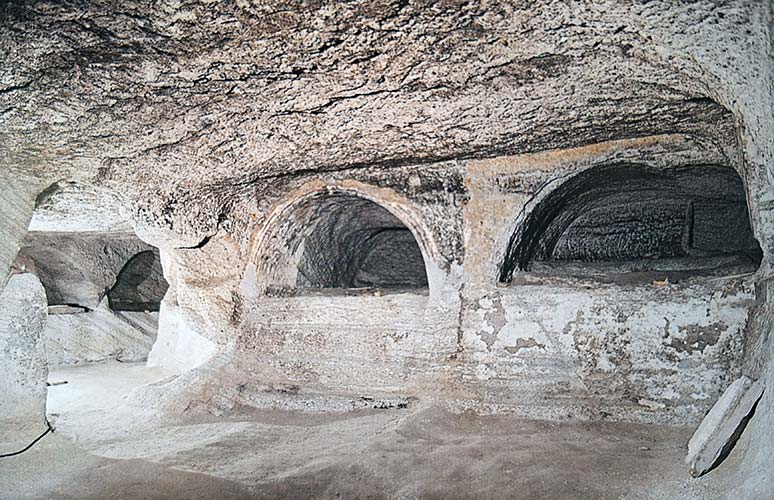
The Milos Catacombs consist of three main galleries (A, B and C), comprising chambers and passageways carved out of volcanic rock (tuff), which are now connected by artificial secondary galleries. The complex is completed by a family burial chamber (cubiculum). The total length of the galleries is approximately 200 m, while the width varies between 1 and 5 m, and the height between 1.6 and 2.5 m. Two types of tomb have been carved into the walls: arcosolia (vaulted tombs) and loculi (horizontal tombs). There are also pit-shaped tombs dug into the ground. All the tombs were covered with slabs, and some arcosolia still retain polychrome decoration on their vaults. These catacombs are thought to have contained between 300 and 1,000 tombs, and several thousand deceased people, both pagans and Christians, as indicated by inscriptions and symbols painted on the arcosolia.
Here is the description of the catacombs provided by archaeologist Niki Tselenti-Papadopoulou, who led the excavations of the catacombs between 2007 and 2009 (http://odysseus.culture.gr/h/3/eh352.jsp?obj_id=834):
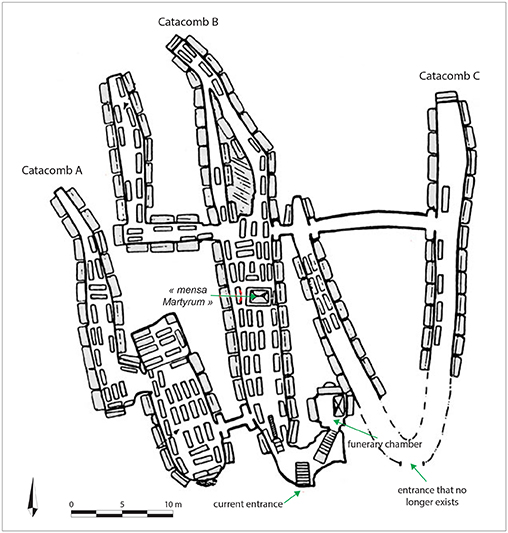
Plan of the catacombs
(© Sotiriou 1928, with some graphic modifications)
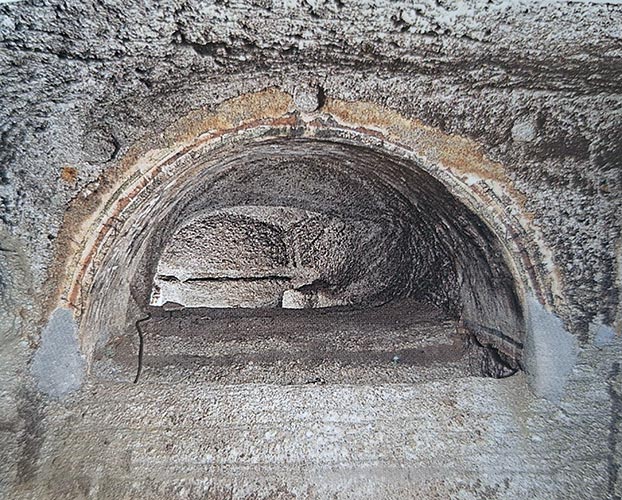
Arcosolium from the Catacomb A, on the rim of which traces of red ribbon remain
(© Gerousi 1999, p. 14, fig. 14)
Gallery 1 of Catacomb A
(© Adobe Stock)
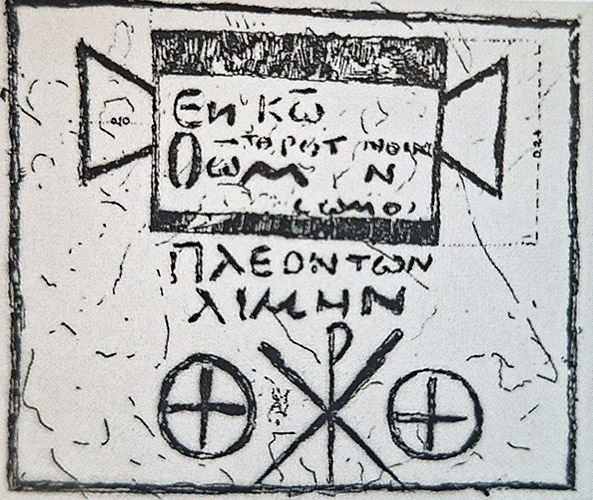
Drawing of an inscription from Catacomb A
(© Sotiriou 1928)
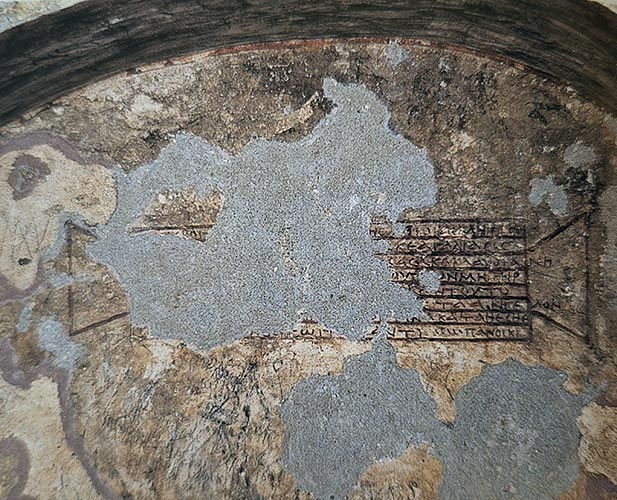
Fragments of an inscription with the names of the deceased (tabula ansata) from Catacomb B
(© Gerousi 1999, p. 16, fig. 12)
Family graves in Catacomb A
(© Gerousi 1999, p. 16, fig. 13)
« The current entrance is located in the Hall of Cacacomb B. On the right side of the room, the unique two-storey arcosolium is preserved and fragments of the important inscription of « Elders », writtent in red capital letters on a rectangular framework (tabula ansata). In the middle of the hall an individual above-groun tomb-shaped sarcophagus has been carved, known as « Tomb of the Witness ». The tomb was probably used as an altar with ciborium, as, above the grave, traces of capitals were found in 1928 by G. Sotiriou.
To the west of Catacomb B lies a second room of Catacomb A. On the north side, arcosolia have been carved in pairs. There are probably family graves. […]
To the east of Catacomb B lies a family burial chamber (cubiculum) and the Catacomb C, not currently acessible. The cubiculum incorporates on its sides three arcosolia and a cist tomb. The southern part of the Catacomb C has collapsed and the two halls are connected by an artificial corridor. In two arcosolia of corridor 2 there are fragments of a scene with flowers and two birds, the Christogram and the letters Ω and A. […]
Few graves gave valuable gems, such as pendants, a metal ring, glass vessesl and glass beads. Bronze and iron nails were also found. Throughout the entire excavation, lamps also were found. Traces of fire, pottery sherds from cooking pots, jugs, plates and animal anf fish bones were found declaring that nekrodeipnon and other burial rites were been taken place.
To the west of the hall of the Catacomb A, a new hall was revealed, but has been temporarily closed off for protection. The original entrance of the hall is located in the northwest. […] »
Further reading
Bayet 1878: C. Bayet, “La nécropole chrétienne de Milo”, Bulletin de Correspondance Hellénique, 2.1, 1878, p. 347‑359.
Bogkli 2017: M. Bogkli, “Οι κατακόμβες της Μήλου: νεότερα ανασκαφικά δεδομένα (2008-2009)” [= “The Catacombs of Milos: latest Excavation data (2008-2009)”], in Το Αρχαιολογικό έργο στα νησιά του Αιγαίου, Mytilene, Ephorate of Antiquities of Lesbos, 2017, p. 497‑510.
Gerousi 1999: E. Gerousi, Μήλος: τα χριστιανικά μνημεία του νησιού [= Milos: the Christian Monuments of the Island], Athens, TAPA, 1999.
Kiourtzian 2000: G. Kiourtzian, Recueil des inscriptions grecques chrétiennes des Cyclades, de la fin du IIIe au VIIe siècle après J.-C., Paris, De Boccard, 2000.
Koch 1994: G. Koch, “Christliche Wiederverwendung attischer Sarkophage”, Boreas: Münstersche Beiträge zur Archäologie, 17, 1994, p. 115‑120.
Sotiriou 1928: G. Sotiriou, “Η χριστιανική κατακόμβη της νήσου Μήλου” [= “The Christian Catacomb on the Island of Milos”], Πρακτικά Ακαδημίας Αθηνών, Γ.1, 1928, p. 33‑46.
Sweetman 2025: R. Sweetman, The Archaeology of the Cyclades in the Roman and Late Antique periods. Globalization, Christianization and Resilience, Cambridge, Cambridge UP, 2025.
Vatta 2007: G. Vatta, “I sarcophagi di Milos”, ArchCl, 63, 2007, p. 535‑558.
Ministry of Culture website: https://cyclades.culture.gov.gr/location/oi-katakomves-tis-milou/